
The Sacrament of Confirmation: Sealed with the Gifts of the Holy Spirit

The Sacrament of Confirmation completes the grace of Baptism, binding you more perfectly to Christ and the Church while strengthening you with the Holy Spirit to live as courageous witnesses to the faith in your daily life—especially as 11th graders at St. Hilary of Poitiers Parish in Raceland, Louisiana, preparing for the challenges of high school, college or work force, and beyond.
What Is Confirmation?
Confirmation is one of the three sacraments of Christian initiation (along with Baptism and Eucharist), forming a unified path to full Christian life. It is a true sacrament instituted by Christ, through which we receive the Holy Spirit to make us strong and perfect Christians and soldiers of Jesus Christ.
“By the sacrament of Confirmation, [the baptized] are more perfectly bound to the Church and are enriched with a special strength of the Holy Spirit. Hence they are, as true witnesses of Christ, more strictly obliged to spread and defend the faith by word and deed.” (Catechism of the Catholic Church, 1285)
In the Roman Rite, like here in our diocese, Confirmation is usually celebrated separately from Baptism (except for adults entering the Church). It begins with renewing your baptismal promises and professing faith, emphasizing that Confirmation builds directly on your Baptism. Every baptized Catholic not yet confirmed can and should receive it, as it completes Christian initiation—Baptism alone leaves it incomplete without Confirmation and Eucharist.
Why Is Confirmation Necessary?
Pope Francis taught us that Confirmation is “for all the faithful what Pentecost was for the entire Church”—a powerful outpouring of the Spirit for growth, mission, and witness. It’s not optional: the Church obliges the faithful to receive it at the appropriate time.
As teens in Raceland, you might hear Confirmation called the “farewell sacrament” or “last rites” because some stop practicing after. But this misses the point—it’s the sacrament of growth and active participation in the Church, not departure. Studies show declines in youth sacraments, but Confirmation equips you to reverse that by living your faith boldly amid peer pressure, social media, or cultural doubts.
Named after St. Hilary of Poitiers, our patron defended the truth of the Trinity (Father, Son, and Holy Spirit as one God) against heresies in his day. Confirmation seals you with that same Holy Spirit, deepening your grasp of this mystery and calling you to defend it today.
The Graces and Effects of Confirmation
Confirmation perfects baptismal grace, rooting you deeper in God’s family, uniting you firmly to Christ, strengthening your Church bond, and empowering mission and witness.
Key effects include:
- Special strength from the Holy Spirit: Like soldiers of Christ, you’re given gifts (wisdom, understanding, counsel, fortitude, knowledge, piety, fear of the Lord) for apostolic life.
- Obligation to witness: You’re called to spread faith “by word and deed,” not just privately but publicly.
- Maturity in faith: If Baptism is birth, Confirmation is growth—preparing you for adult discipleship.
“Confirmation perfects Baptismal grace; it is the sacrament which gives the Holy Spirit in order to root us more deeply in the divine filiation, incorporate us more firmly into Christ, strengthen our bond with the Church, associate us more closely with her mission, and help us bear witness to the Christian faith in words accompanied by deeds.” (Cathechism of the Catholic Church, 1316)
Preparation for Confirmation at St. Hilary
Your 11th-grade preparation should foster intimate union with Christ and familiarity with the Holy Spirit—His gifts, actions, and call. Focus on:
- Sense of belonging: To the universal Church and our parish family in Raceland.
- Apostolic responsibilities: Learning to share faith through prayer, liturgy, morals (Ten Commandments, Beatitudes), and community.
- Full Gospel message: As St. John Paul II urged U.S. bishops, present Christ’s full teaching via the Catechism, countering shallow views like “Moralistic Therapeutic Deism.”
Parish programs, youth ministry, and family support align with national frameworks like Listen, Teach, Send, emphasizing sacraments as transformative encounters with Christ.
The Rite of Confirmation
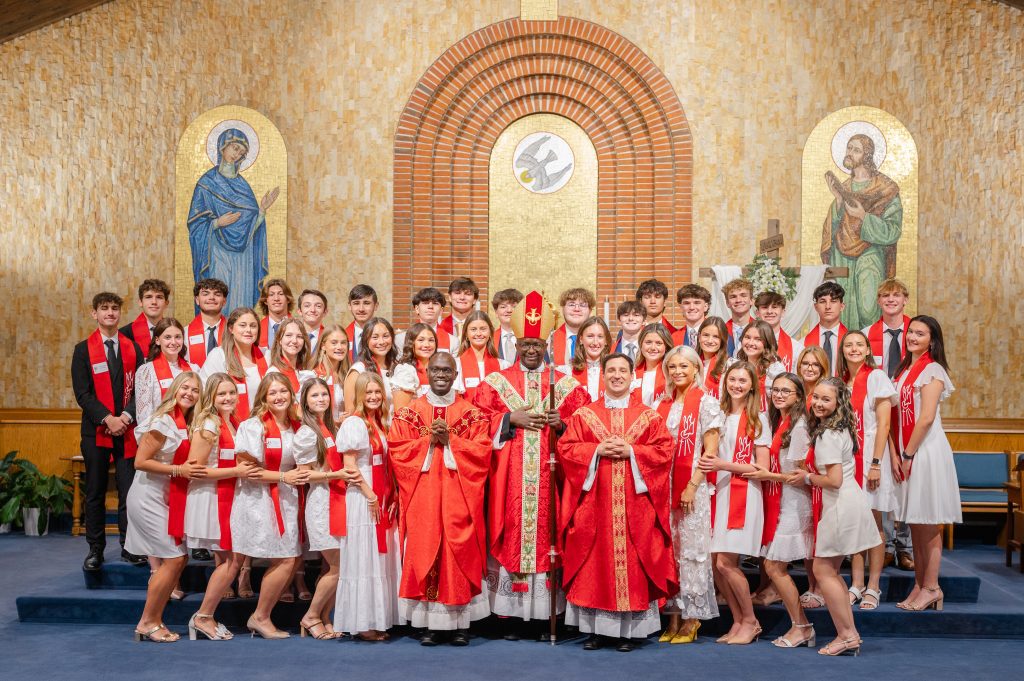
The bishop (or delegated priest) anoints your forehead with chrism oil, saying: “N., be sealed with the Gift of the Holy Spirit.” You respond, “Amen.” Hands are imposed, invoking the Spirit. This echoes Pentecost, commissioning you as missionaries.
Living Confirmation in Raceland
As 11th graders, Confirmation arms you against local challenges—like hurricane recovery faith, Louisiana culture, or teen temptations. It’s your “Pentecost moment”: step up as leaders in St. Hilary’s youth group, defend life issues, or invite friends to Mass. Don’t let it be a “graduation”—make it your launch into lifelong mission.
In summary, Confirmation seals you indelibly with the Holy Spirit, completing Baptism and empowering witness. Prepare prayerfully, receive it worthily, and live it daily—be the strong Christians St. Hilary would cheer for.